Moulding
The iPod dock that i designed has three major parts; the front housing, the centre cylinder (docking area) and the back housing, these are shown in the image below. Having three separate parts made the most sense for moulding purposes. These can be seen below and are 100% mouldable.
Initially, I planned for my dock to be made from a two-part mould. Although this was possible it proved un-economical due to the complexity needed within the moulding tool. Another reason why I chose to have my dock made from three parts was so that the centre housing could be a different colour from the front and back housing, this was vital to my design in order to keep the Dyson brand language.

Front Housing
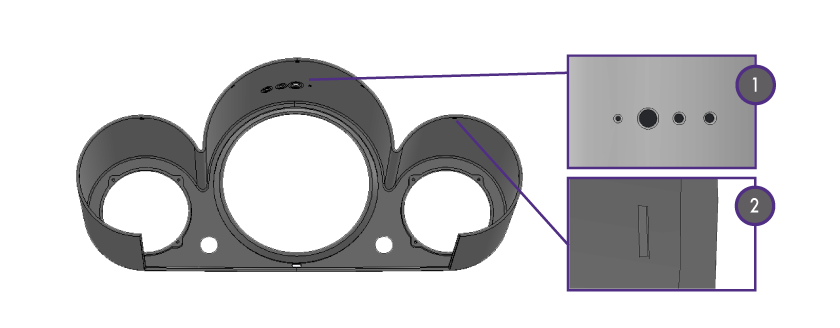
The front housing is made from a two-part mould. One part comes in from the front the other comes in from the back. The mould also has inserts on the top to make the buttonholes.

The Main image below shows the front housing of the dock from the back view. Detail 1 shows the holes where the buttons go for power and volume, these are made with inserts. Detail 2 shows where the snap hooks clip in these are made with sliding cores.
Centre Housing
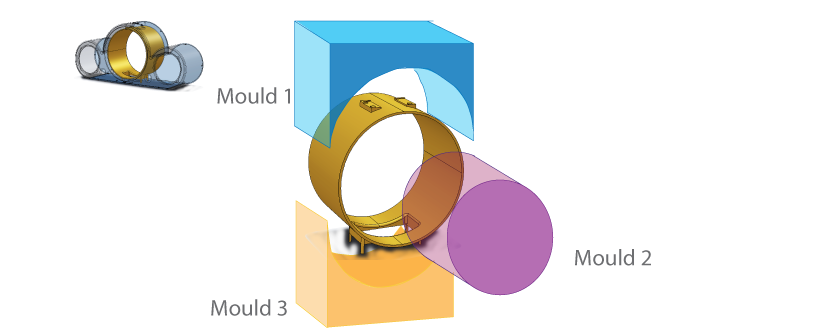
The centre housing is made from a 3-part mould. Part one comes from the top, part two slides in the middle and part three comes from the bottom. Part two also has an insert to create the hole for the universal well.
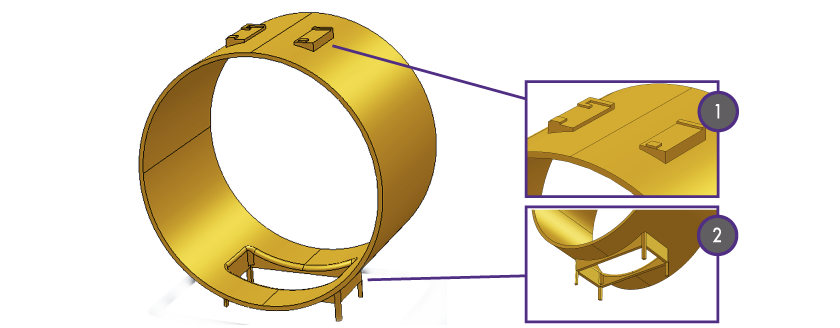
The main image below shows the centre housing of the dock from the front view. Detail 1 shows the are in which the button PCB sits. Detail 2 shows the bottom of the part where it sits on the front housing; this hole is done with an insert.
Back housing
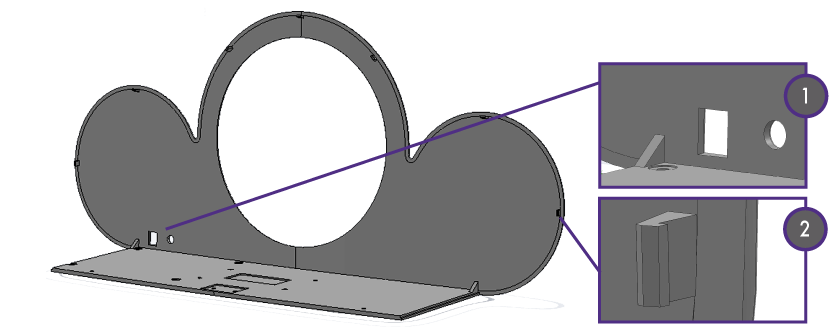
The back housing is made from a 2 part mould. Part one comes from the rear, part two comes in from the front. Part one also has an insert to create the holes for power supply and the audio output.

The Main image shows the back housing of the dock from the front view. Detail 1 shows the holes where the power and output sit these are made with inserts. Detail 2 shows the snap hooks that are made with sliding cores.